All Categories
Featured
Cloud services are essential for digital change, allowing businesses to innovate faster, operate more effectively, and provide better consumer experiences. In a rapidly digitizing world, cloud facilities has actually ended up being more than just an IT upgradeit's a strategic requirement. Enterprises today deal with growing needs for scalability, real-time information gain access to, boosted cooperation, and robust security.
This is where come into play. Here are crucial reasons why enterprises are moving to the cloud: Cloud infrastructure allows businesses to scale resources up or down based on demandideal for varying work and growing user bases. Whether you're introducing a brand-new product or expanding internationally, cloud services support your journey without upfront hardware expenses.
Cloud computing gets rid of capital investment and turns it into foreseeable operational expenses. Cloud environments make it possible for seamless partnership among dispersed teams. Employees can access files, applications, and data in genuine time, increasing productivity and allowing remote work. Cloud platforms support rapid advancement, screening, and deployment of applications. With tools like CI/CD pipelines, business can launch updates and brand-new features much faster than ever.
The Landscape of Corporate R&D in 2026Cloud options supply automatic backups, redundancy, and failover systems that ensure company continuityeven in the face of cyberattacks, system failures, or natural catastrophes. Cloud platforms typically integrate AI, artificial intelligence, IoT, huge data analytics, and blockchainenabling enterprises to innovate and stay competitive in the digital economy. Adopting cloud computing is no longer just an IT upgradeit's a strategic relocation that empowers organizations to run more efficiently, innovate faster, and stay ahead in a competitive digital environment.
Here are a few of the key advantages business gain by partnering with: Cloud computing removes the need for big capital expenses on software and hardware. With a pay-as-you-go model, you only pay for what you utilize, resulting in much better budget control and expense efficiency. Whether you're scaling as much as manage increased need or reducing throughout off-peak times, cloud services offer on-demand flexibility that adjusts to your organization needsinstantly.
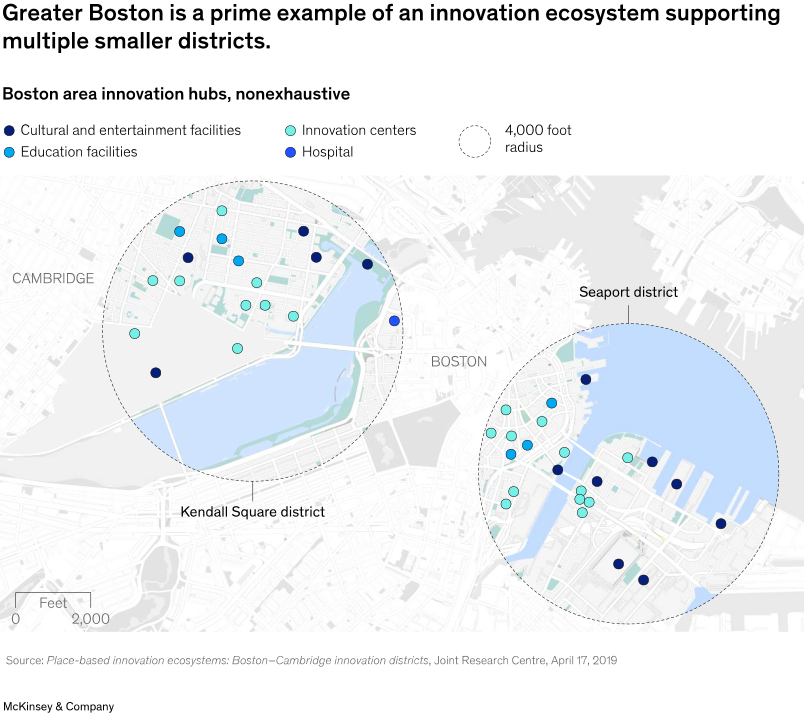
How to Build Enterprise R&D Nodes
With tools for automation, testing, and deployment, teams can react quickly to market changes. Cloud services make it possible for employees to gain access to applications and data from anywhere, supporting hybrid and remote work models. Groups can collaborate in real time, improving efficiency and communication. Top invest greatly in security functions such as file encryption, identity and access management, firewalls, and compliance certificationsoften more robust than what numerous organizations can implement on-premises.
Cloud service suppliers manage and upgrade software frequently, so you constantly have access to the newest features, bug fixes, and security enhancementswithout disrupting your operations. Cloud computing supports greener operations by reducing the need for physical hardware and making it possible for more efficient energy use through optimized data centers. Cloud service providers frequently incorporate AI, maker learning, information analytics, and IoT toolsallowing businesses to innovate and extract more worth from their data without purchasing additional infrastructure.

From infrastructure to platforms and SaaS services, these are at the forefront of powering digital improvement throughout industries. Below is a list of a few of the most trusted and extensively utilized in the market: The indisputable leader in cloud computing, AWS offers an extensive suite of IaaS, PaaS, and serverless options.
Known for its data analytics, AI/ML abilities, and deep integration with Google Work area, GCP is perfect for organizations focused on innovation and huge data applications. A close competitor to AWS, Azure uses strong business integrationespecially for organizations currently using Microsoft products. It supports hybrid cloud environments, DevOps, and a vast marketplace of services.
With a strong emphasis on AI, security, and enterprise applications, IBM Cloud supports hybrid cloud setups and advanced technologies like quantum computing and blockchain. Focusing on virtualization and hybrid cloud environments, VMware Cloud enables companies to manage work across on-premises facilities and public clouds with constant operations and tools. As one of the pioneers in cloud-based CRM, Salesforce offers a powerful suite of SaaS items for marketing, sales, customer support, and analyticsall hosted securely on the cloud.
How Innovation Hubs Drive Enterprise Growth
Its dominance shows the continuous shift toward scalable, on-demand cloud facilities across industries. This momentum is only anticipated to grow, with the cloud computing sector predicted to broaden by $65 billion by the end of 2023underscoring the critical function AWS plays in driving digital improvement worldwide.
Explore this curated list of leading cloud service business that can assist your service leverage cloud computing for scalability, agility, and development. DEV IT (Dev Information Technology Limited) is a global IT services and digital change business with over 28 years of experience in providing scalable, secure, and business-driven technology solutions.

Latest Posts
Merging Edge Computing with Innovation Workflows
Leveraging Hybrid Computing in Enterprise Systems
R&D Centers Vs. Traditional Enterprise Laboratories